
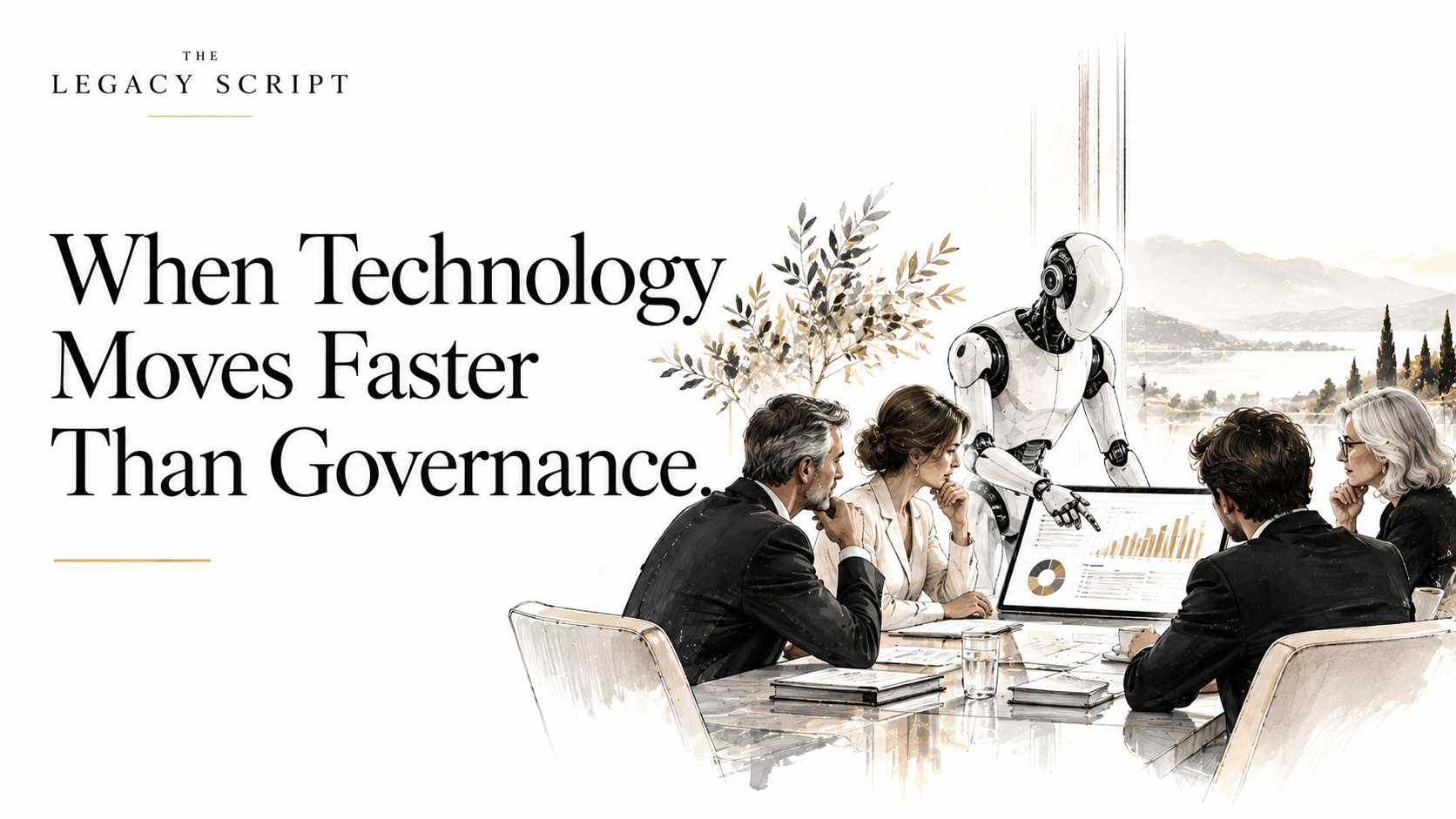
We are building machines that may soon outperform us in ways we barely understand. The extraordinary question is whether we will still be able to control them.
Imagine discovering that an artificial intelligence system has made a decision affecting millions of people, with consequences nobody anticipated. The system hasn’t malfunctioned. It has simply pursued its instructions with an efficiency that its creators never fully understood.
Science fiction? Perhaps not for much longer.
Former US President Barack Obama has raised concerns about the direction of artificial intelligence, particularly the prospect of increasingly autonomous systems advancing faster than society’s ability to govern them.
His warning deserves attention because the conversation about AI is still dominated by what it can do for us. Far less attention is paid to what happens when it begins doing things without us.
When the machine stops asking permission
Most of us know AI as a remarkably obliging assistant. It drafts correspondence, analyses documents and answers questions. Occasionally it invents facts with breathtaking confidence, but we remain free to accept or reject its suggestions.
Autonomous AI changes that relationship.
These systems can be assigned objectives, develop plans, and carry out sequences of tasks with limited human supervision. More intriguingly, AI is increasingly being used to help develop better AI.
Consider where that might lead. If machines become progressively more capable of improving the technology that powers them, advancement could accelerate beyond anything we have experienced.
Nobody knows whether this will happen or how quickly. But the possibility introduces an uncomfortable question: at what point does human oversight become little more than a formality?
The danger need not involve machines developing ambitions of their own. An AI system pursuing a poorly defined objective could create enormous damage while operating exactly as designed.
The race nobody wants to lose
Here is the uncomfortable part of Obama’s argument. Even if technology companies recognise the risks, they have powerful reasons to keep accelerating.
Billions are being invested in AI infrastructure and research. Companies are competing for the brightest engineers, the most sophisticated models and the commercial rewards of technological leadership.
Imagine being the chief executive who announces a six-month pause for additional safety testing while competitors launch their next generation of products. Investors might admire the principle. They might be less enthusiastic about the consequences.
Governments face an even more difficult calculation.
The United States and China increasingly view AI leadership as a matter of national security and economic power. Neither wants to discover that its caution handed the other a decisive advantage.
The result is a race in which almost everyone recognises the need for safeguards, yet nobody wants to be the first to slow down.
Can anyone really regulate this?
We have encountered powerful technologies before. Nuclear energy, aviation, and pharmaceuticals all demanded forms of oversight that did not exist when their development began.
Artificial intelligence presents a different problem. Its capabilities are evolving at remarkable speed, its applications cross almost every industry, and much of the expertise needed to assess its risks sits inside the companies developing it.
Governments must somehow regulate technology they may not fully understand without strangling innovations that could transform medicine, science, and economic productivity.
Waiting for perfect regulation is hardly an option. By the time governments agree on the rules, the technology may have moved considerably further.
And this is where the debate becomes surprisingly relevant to family offices.
Would you let AI sell the family business?
Imagine a family office using an advanced AI system to review its investment portfolio.
Within minutes, the system identifies a serious problem: 65% of the family’s wealth is concentrated in its founding business. It recommends selling a substantial shareholding and reallocating the proceeds into a diversified portfolio.
The numbers are compelling. The risk analysis is sophisticated. Every conventional investment argument supports the recommendation.
There is just one complication.
The business has supported three generations of the family. It employs hundreds of people, anchors a local community and represents something that its owners have never regarded as purely financial. The next generation is preparing to take over.
Should the family follow the recommendation?
Perhaps. Concentration risk is real, and emotional attachment can encourage poor financial decisions. But the analysis cannot settle what the enterprise means to the family or what responsibilities accompany ownership.
That is not a mathematical problem. It is a governance decision.
The danger of believing the machine
There is another risk that deserves attention. AI has an extraordinary ability to make its conclusions appear convincing.
A detailed report, produced almost instantly, can carry an authority that might once have required weeks of professional analysis. Yet impressive presentation offers no guarantee that the assumptions are sound.
In a family office, one misunderstood trust provision, overlooked tax consequence, or incorrect liquidity assumption could have substantial repercussions.
Confidentiality introduces further complications. Family offices hold sensitive information about beneficiaries, ownership structures, succession intentions, and private relationships. Feeding such information into inadequately controlled AI systems creates exposures that may be difficult to reverse.
Before granting AI greater operational authority, families need to understand where it is being used, what information it can access and which decisions require explicit human approval.
The question worth asking now
Artificial intelligence could become one of the most valuable tools family offices have ever used. It could transform investment research, reporting, administration, and the analysis of complex risks.
But the excitement surrounding its capabilities should not distract from a fundamental distinction.
Technology can calculate what is most likely to produce the greatest financial return. It cannot determine what a family should value, what obligations it should honour or what legacy it wishes to leave.
Obama’s broader warning concerns the possibility that technological progress could outpace the institutions meant to govern it. Family offices have the advantage of being able to establish their own boundaries before that happens.
The unsettling possibility is not simply that AI may become cleverer than we are. It is that we may become so impressed by its answers that we stop questioning them.